ESA's Hera spots Didymos and starts braking for its asteroid rendezvous
Two years after launch, ESA's planetary-defence probe Hera has caught its first glimpse of the Didymos binary asteroid and begun a series of braking burns.
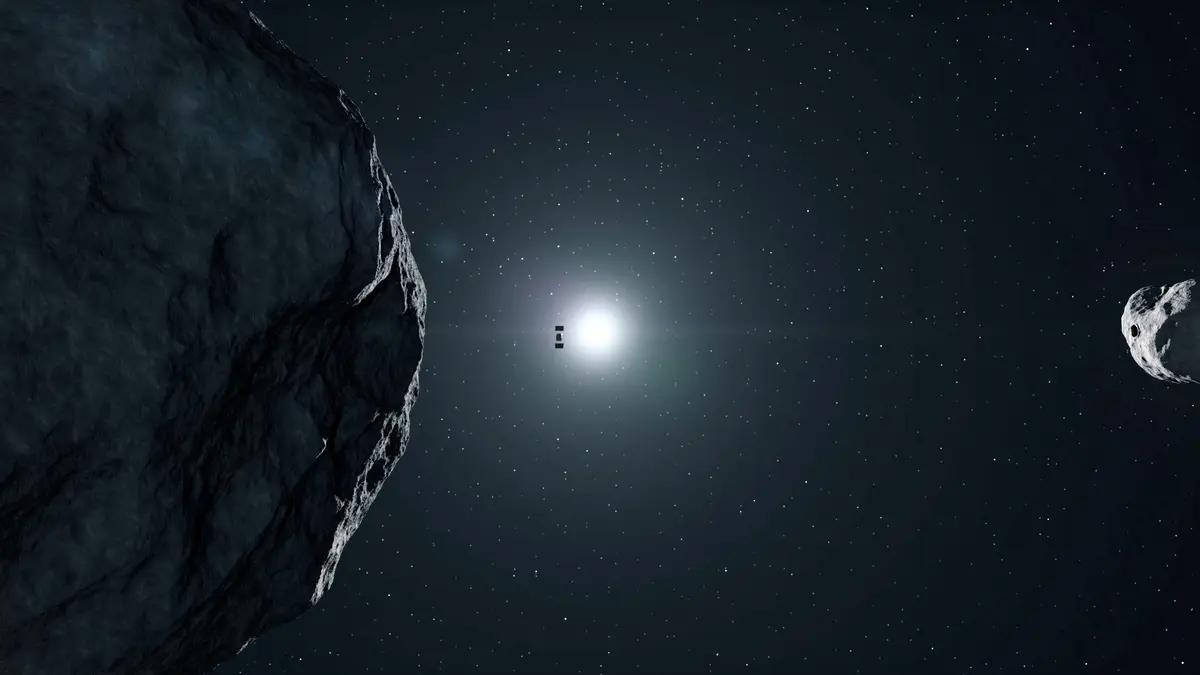
The European Space Agency's Hera mission is closing in on its target. Two years after launch, the planetary-defence spacecraft has taken its first look at the Didymos binary asteroid system and is now in the most demanding phase of its cruise: slowing down.
First glimpse
ESA says Hera spotted Didymos from an approximate distance of 236,500 km. By combining multiple images and performing photometric analysis, the team identified the asteroid system against the background stars in visible light. It appears smaller than a single pixel, but bright enough for the camera to detect.
Didymos is a binary system: the 780-metre Didymos is orbited by the 150-metre moonlet Dimorphos. In September 2022, NASA's DART spacecraft deliberately crashed into Dimorphos, changing its orbit around Didymos and demonstrating asteroid deflection for the first time. ESA notes that Dimorphos is the first Solar System object to have been transformed by human action.
Time to brake
Hera launched from Cape Canaveral on October 7, 2024. Since then it has flown two deep-space manoeuvres and a spring 2025 Mars flyby that changed its course and increased its speed. ESA says it is travelling at more than 12 km per second relative to Earth.
To match the velocity of the asteroids, ESA planned a sequence of braking burns:
- BRM-1, October 15: Hera turns so its ring of Orbit Control Thrusters faces the Didymos system. Three of these hydrazine thrusters fire together for a total of 93 minutes, cutting Hera's velocity relative to the asteroids by a few hundred metres per second. A short test burn was performed on October 2.
- BRM-2, October 22: a second, roughly 31-minute burn to complete most of the remaining velocity change and correct for any under- or over-performance of the first.
- Late October: three smaller "transition" manoeuvres to bring Hera's relative velocity down to near zero.
ESA's flight dynamics team will confirm each burn using Hera's guidance, navigation and control telemetry plus ranging and Doppler data from its deep-space antennas, including the 35-metre station at New Norcia, Australia.
Why it matters
DART showed an asteroid can be nudged. Hera's job is the close-up "crash scene investigation": measuring in detail how Dimorphos responded to the impact. ESA says those measurements should help turn the DART experiment into a well-understood and potentially repeatable planetary-defence technique.
For the space economy, Hera is a flagship for European deep-space navigation and small-body operations, skills that also matter for future asteroid science and resource missions.